Quick answer
ChatGPT Ads are now available to eligible UK advertisers through OpenAI’s Ads Manager Beta.
Ads appear beneath relevant ChatGPT responses and are matched using the context of the conversation, the advertiser’s creative and information from the landing page. Advertisers can currently run cost-per-click or cost-per-thousand-impressions campaigns.
However, the platform is still in beta. Access is restricted, performance benchmarks are limited and not every UK ChatGPT user will see ads. For most businesses, ChatGPT Ads should be treated as a controlled test rather than a replacement for Google Ads, Meta or other established channels.
What is happening with ChatGPT Ads in the UK?
The ChatGPT advertising era is well and truly underway. Following an initial test in the US, OpenAI launched its self-service advertising platform to businesses in the UK.
Eligible advertisers can now create an account, upload creative, set bids and budgets, and manage campaigns through Ads Manager Beta.
OpenAI is rolling out ads gradually, with ads limited to eligible users on ChatGPT’s Free and Go plans. Users on Plus, Pro, Business, Enterprise and Edu plans do not see them. Accounts belonging to people OpenAI knows or predicts are under 18 are also excluded.
While ChatGPT has become a household name following its rapid rise since its release in 2022, the platform’s partners are in a massive $96 billion debt due to huge investment and operations costs. This debt has likely accelerated the launch of ads in the UK, with OpenAI declaring that advertising will help fund continued access to its free and lower-cost services.
For marketers and business owners, the more significant point is that ChatGPT has become a paid media channel as well as an organic discovery platform. Businesses can now pay to reach people while they are researching products, comparing providers or trying to solve a problem.
How do ChatGPT Ads work?
ChatGPT Ads are sponsored placements displayed beneath relevant responses.
They are clearly labelled and separated from ChatGPT’s answer. OpenAI says advertisers cannot pay to influence the response itself.
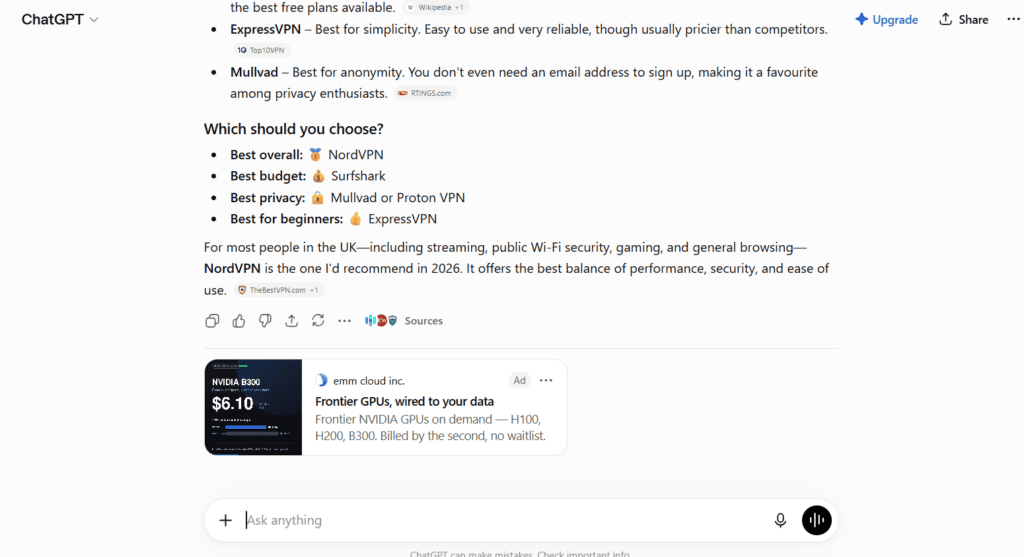
An example of a ChatGPT Ad we found for the prompt “What are the best VPNs to use in 2026?”
A typical ad can include:
- An advertiser name and logo
- A headline and description
- An image
- A link to a landing page
Unlike a standard search ad, the placement is not based solely on an individual query. OpenAI can consider the wider conversation when deciding whether an ad is relevant.
Where do the ads appear?
Ads appear below a ChatGPT response when OpenAI identifies a suitable commercial match.
They are not shown in every conversation. The platform considers the topic, the apparent intent of the user and whether advertising would be appropriate in that context.
OpenAI also restricts ads around sensitive subjects, including personal crises, political content and other high-risk topics.
This means available inventory may be narrower than on Google or Meta, particularly during the early rollout.
How are ads matched to users?
Advertisers provide headlines, descriptions, images and a landing page. The main difference from traditional ad platforms is targeting. While advertisers typically bid on keywords, ChatGPT Ads run off context hints describing the types of conversations in which the offer may be useful.
OpenAI provides the following guidelines to context hints:
“Describe the conversations, topics, or keywords where your products or services may be relevant; these hints guide matching but aren’t exact-match targeting rules.”
An accountancy software provider, for example, might use themes related to late invoices, cash flow management, financial reporting and bookkeeping admin. Its ad could then be considered when a user discusses one of those problems, even if they never type “accounting software”.
While its targeting currently appears less refined than the systems available on established platforms, the setup offers an early indication of how campaigns may need to be planned.
Instead of simply transferring a Google Ads keyword list, advertisers need to understand:
- The problems customers are trying to solve
- The questions they ask before buying
- The alternatives they compare
- The information that moves them closer to a decision
- How they might articulate their problems within prompts
That wider context is the platform’s main potential advantage. A conversation may reveal more about a customer’s needs than a short search query.
How are campaigns bought and measured?
ChatGPT Ads currently support two main objectives.
- Views campaigns use CPM pricing, meaning advertisers pay per 1,000 impressions.
- Clicks campaigns use CPC pricing, meaning advertisers pay when somebody makes a valid click.
Advertisers set maximum bids, but delivery is not based on bid alone. OpenAI uses a relevance-weighted auction, so a closely matched ad may outperform a higher bidder with a weaker connection to the conversation.
Ads Manager reports metrics including impressions, clicks, spend, click-through rate, average CPC, average CPM and conversions.
Conversions are tracked similarly to other major ad platforms. Advertisers can install OpenAI’s conversion pixel or use its Conversions API to measure actions such as purchases and lead submissions.
Advertisers can also add UTM parameters and analyse traffic in platforms such as GA4. Where possible, campaign data should be connected to CRM outcomes or ecommerce revenue.
Can anyone sign up for ChatGPT Ads?
UK businesses can apply through OpenAI’s Ads Manager Beta, but access and campaign approval are not automatic.
The setup process includes:
- Creating an advertiser account
- Adding business information
- Completing verification
- Setting up billing
- Creating and submitting campaigns
OpenAI reviews the advertiser, its products and its advertising content. Campaigns cannot run until the required verification and billing steps have been completed.
Advertisers should check their account details carefully during setup. Information such as the country, billing currency and time zone may not be changeable afterwards.
Which businesses are eligible?
OpenAI is initially supporting categories including:
- Lifestyle and household products
- Local services
- Travel and experiences
- Digital products
- Education
Some regulated businesses, including those in healthcare, financial services and legal services, may be reviewed manually.
Approval depends on the entire customer journey. The advert may comply with policy, but it can still be rejected if the landing page contains misleading, restricted or unsupported content.
Which products and services are restricted?
Restricted areas currently include:
- Political advertising
- Gambling
- Alcohol, tobacco and nicotine
- Adult content and dating services
- Weapons
- Illegal or counterfeit products
- Misleading financial opportunities
- Unsupported health claims
Advertisers must also avoid deceptive pricing, exaggerated outcomes and claims they cannot substantiate.
Policies are likely to change as the platform develops, so eligibility should be checked before campaign planning begins.
How much do ChatGPT Ads cost?
There is no fixed price for ChatGPT Ads, but OpenAI currently sets a minimum daily budget of $25 per campaign. UK advertisers should check the amount shown in their account, as billing options and platform requirements may change during the beta.
Costs are determined through an auction and may be influenced by:
- The campaign objective
- The maximum bid
- Competition
- Relevance to the conversation
- Creative quality
- Landing-page quality
- Available inventory
OpenAI currently recommends that CPC advertisers begin with a maximum bid of around $3 to $5 per click.
That is a starting recommendation, not a UK benchmark. Actual costs could be higher or lower depending on the auction.
There is not yet enough reliable data to define a good average CPC, conversion rate, cost per lead or return on ad spend for UK advertisers. Any agency or platform claiming firm industry benchmarks at this stage should therefore be treated cautiously.
CPC and CPM pricing
CPC campaigns are likely to be the most practical starting point for businesses focused on leads or sales.
The advertiser pays for clicks and can compare the resulting traffic with Google Ads, Meta and other acquisition channels.
CPM campaigns focus on visibility. They may suit product launches or awareness campaigns, but impressions alone do not demonstrate commercial value. Advertisers still need to measure whether that exposure contributes to website visits, searches, enquiries or sales.
Should your business run ChatGPT Ads now?
Whether you should run ChatGPT Ads right now depends largely on your marketing budget.
The platform is still in beta, so its targeting, reporting and optimisation tools are still relatively limited, and also likely to change. Reach is also restricted because paid plans are ad-free, under-18 users are excluded and ads are not shown in every conversation.
Advertisers also have less control and less historical data than they do on mature platforms. There are no established benchmarks, widely tested campaign structures or proven optimisation methods.
Along with this, ChatGPT Ads can allegedly get very expensive fast, for little reward by way of leads. We wouldn’t recommend them to small businesses, or those with strict marketing budgets.
However, ChatGPT Ads are worth testing when the business is prepared to treat them as an experiment.
A test may make sense when:
- Customers research the product or service in detail
- The offer solves a specific problem
- The business has strong landing pages
- Conversion tracking is reliable
- Existing paid campaigns are stable
- There is a separate testing budget
- The industry is eligible
The platform may be particularly relevant for ecommerce, software, education, travel and considered service purchases where customers compare several options before deciding.
Agencies testing the platform early may also gain a first-mover advantage by building practical knowledge before ChatGPT Ads become more widely adopted.
It may be better to wait when:
- The marketing budget is already stretched
- Existing campaigns are underperforming
- Leads or sales cannot be tracked accurately
- The industry faces strict restrictions
- The business requires predictable acquisition costs
- Precise keyword or local targeting is essential
The fact that ChatGPT Ads are new is not, by itself, a reason to use them.
If a profitable Google Ads campaign still has room to grow, increasing investment there may produce a stronger return. ChatGPT Ads should initially complement proven channels, not displace them.
A sensible test would focus on one commercial use case, compare lead or sales quality with other channels and scale only when the results justify it.
The opportunity is real, but so is the uncertainty.
Final verdict: Are ChatGPT Ads worth testing?
ChatGPT Ads give UK businesses a new way to reach potential customers during research and comparison.
Their main advantage is the ability to match advertising with the wider context of a conversation rather than a single keyword. That could be valuable for products and services that require explanation or careful consideration.
However, the platform remains unproven. Costs are difficult to predict, reach is limited and established performance benchmarks do not yet exist.
Businesses with suitable products, reliable tracking and budget for experimentation should consider a controlled test.
Businesses still struggling with established channels should improve those first.
For now, ChatGPT Ads are best treated as an additional testing opportunity, not the centre of a paid-media strategy.
If you are considering ChatGPT Ads but are unsure whether the platform is right for your business, get in touch with Bright Sprout. Our PPC specialists can assess the opportunity, review your tracking setup and help you plan a controlled test.
To learn more about how to make the most of ChatGPT and other LLMs as tools, explore our article on the best AI assistants.
Frequently asked questions
Are ChatGPT Ads available in the UK?
Yes. Eligible UK businesses can apply for access through OpenAI’s Ads Manager Beta. Verification and campaign approval are required.
Do ChatGPT Ads use keywords?
Not in the same way as traditional search ads. Advertisers use context hints, while OpenAI considers the wider topic and intent of the conversation.
How much do ChatGPT Ads cost?
There is no fixed cost. Advertisers can use CPC or CPM pricing and set maximum bids. OpenAI currently recommends a starting maximum CPC bid of around $3 to $5.
Can ChatGPT Ads track conversions?
Yes. Advertisers can use conversion tracking and UTM parameters to analyse results in platforms such as GA4.
Do ads influence ChatGPT’s answers?
No. OpenAI says sponsored placements are kept separate from ChatGPT’s response and advertisers cannot pay to influence the answer.