
Marketing should make your business money. That’s hard to argue with.
So, when deciding where to invest, it naturally makes sense to look at which channels generate the most leads, sales, and revenue. The problem, however, is when this becomes the only way we measure marketing success.
Customers rarely see one advert and immediately buy. They search, scroll, compare, read reviews, visit websites and encounter brands several times before purchasing. Some of those interactions are easy to measure, while others aren’t.
Understanding how to measure marketing success therefore means looking beyond which platform received credit for the final conversion and considering the role each part of your marketing played in getting the customer there.
Quick answer: how do you measure marketing success?
Marketing success should be measured against the purpose of each activity. Revenue, leads and return on investment remain important overall measures, but they don’t tell you everything about how customers discover and choose your business.
Use different metrics for different stages of the customer journey, then assess whether your marketing channels are collectively helping the business generate awareness, consideration, enquiries and sales.
What does marketing success actually look like?
Frustratingly for marketers, there’s not one single metric that tells you whether everything is working. A business might invest in marketing with the goal of increasing revenue, but individual marketing activities have vastly different jobs on the way to achieving that.
Put it this way; you’re at home scrolling, and you see a social media post from your favourite local takeaway. A couple of days later, you’re ordering Deliveroo, and subconsciously remembering that post, you decide you’re going to order said takeaway. That post nudged you to order, but the business won’t know or see that in their metrics.
Digging deeper:
- A social media campaign might increase awareness among potential customers.
- An SEO article could introduce your business to someone researching a problem.
- A Google Ads campaign might capture someone actively looking for your service.
- A case study could reassure that person that you are the right company to contact.
- Your website then needs to turn interest into enquiries.
Each channel contributes to the final outcome, but measuring every activity solely by the revenue directly attributed to it can produce a misleading picture. That doesn’t mean abandoning ROI. It means understanding what sits behind it.
Why ROI doesn’t tell the whole story
Return on investment is valuable because it connects marketing spend to commercial results. If you spend £1,000 on advertising and generate £5,000 in profitable sales as a direct result, that is information worth knowing.
The difficulty is the phrase “as a direct result”, because some marketing channels make that connection much easier to see than others.
Moreover, a study by Neil Patel found 35% of small business customer journeys began on social media. If social media is judged only by the revenue directly attributed to it, its role as a discovery and awareness channel can easily be overlooked.
Why PPC can look like the clear winner
A lot of marketing managers have tunnel vision on PPC. This is because paid search is often one of the easiest channels to measure and attribute value to. Someone searches for a product or service, clicks an advert, and submits an enquiry, so tracking records the conversion and Google Ads receives the credit.
But consider a more realistic customer journey:
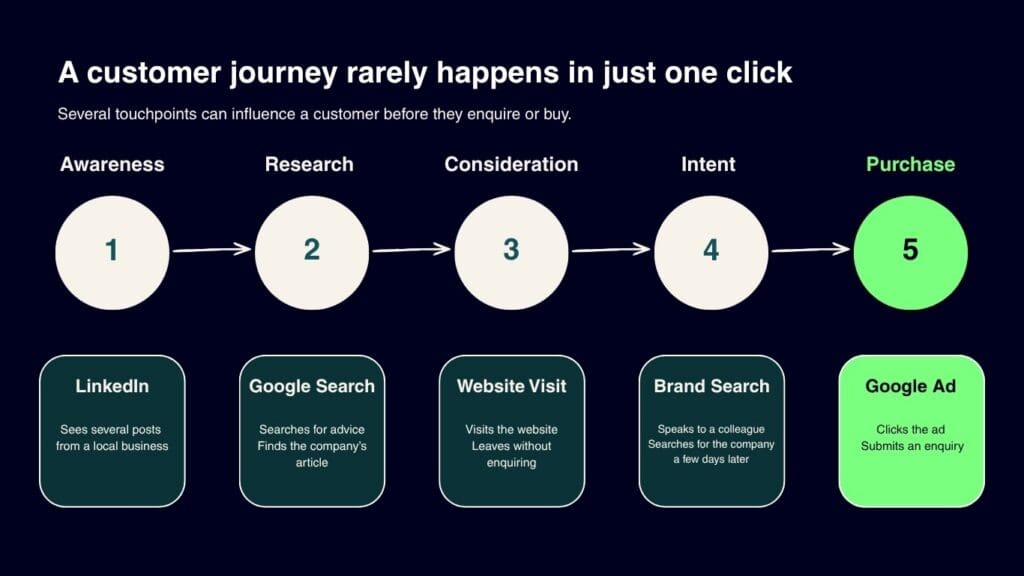
The Google Ads campaign may record the conversion, but did PPC single-handedly generate that customer? Probably not.
Social media helped establish familiarity. SEO made the business discoverable during research. The website helped establish trust, and PPC eventually captured their intent. The channel receiving credit for the conversion is not necessarily the only channel that contributed to it.
While ROI should not be the only measure of marketing success, improving campaign efficiency still matters. These simple ways to increase Google Ads ROI are a useful starting point for businesses looking to get more from their paid search activity.
Your customers don’t think in marketing channels
Businesses separate marketing into SEO, PPC, and social media because it makes planning and reporting easier. Customers don’t. They simply interact with your business wherever they encounter it.
Awareness
The customer first becomes aware of your business, product, or the problem they need to solve. Social media, video, PR, advertising, and informational search content can all contribute.
Consideration
The customer begins researching their options. They may search Google, read articles, look at reviews, browse social profiles, compare competitors, or return to your website several times.
Decision
The customer is ready to act. A high-intent search, branded Google search, remarketing advert, email or direct website visit might finally generate the enquiry or sale.
No channel belongs exclusively to one stage. SEO can generate awareness and direct enquiries, PPC can introduce a brand as well as capture existing demand, and social media can build recognition while sometimes generating sales directly. Effective marketing puts your business in front of potential customers at the moments that matter.
PPC doesn’t operate in a vacuum
PPC can be incredibly effective on its own, particularly when there is existing demand for your product or service. If someone searches “accountant near me”, “replacement windows Bristol” or “commercial solicitor”, appearing prominently at that exact moment has obvious value.
But there is another question worth asking: what made that person search in the first place?
Perhaps they had seen the company on social media, somebody had recommended the brand, or they had previously read a blog post, seen an advert or visited the website. Marketing further up the funnel can create familiarity before a customer demonstrates clear buying intent.
That’s why PPC, SEO and social media shouldn’t always be treated as competitors for the same budget. Social can create familiarity, SEO can make your business discoverable, PPC can capture demand, and your website can convert it.
Each service can perform extremely well individually. Often, though, the strongest strategy is one where those channels complement each other.
Integrated strategies are something we value deeply at Bright Sprout. Throughout our work with Chiropractic Care Clinics, we combined website development, SEO, content marketing, social media, paid advertising and local brand-building. The joined-up strategy has contributed to more than 50% growth in monthly website traffic and a 66% average increase in new patient numbers.
Undervaluing social and SEO is one of the most common mistakes we see business owners make.
Imagine you receive your first social media marketing report and see that organic social generates very few last-click conversions. The obvious conclusion could be to stop investing in it, but what if customers regularly see your posts before searching for your company later? What if your social profile reassures prospective customers that the business is active, credible and knowledgeable?
That activity has value, even though assigning an exact pound figure to every post may be impossible.
The same applies to SEO. An informational article might attract somebody months before they are ready to buy, answer their question, introduce your brand and give them a reason to return later.
If you only look at immediate conversions, that article might appear unsuccessful. Look at relevant organic visibility, qualified traffic and the wider customer journey, and the picture can change.
Use the right metrics for the job
Before identifying which metrics to track, it’s crucial to understand what they actually tell you.
| Metric | What it stands for | What it tells you |
| ROI | Return on Investment | Whether the return justifies the overall investment |
| ROAS | Return on Ad Spend | Revenue generated compared with advertising spend |
| CPA | Cost per Acquisition | What you’re paying for each customer or conversion |
| Conversion rate | Percentage of users who convert | How effectively traffic turns into action |
| CTR | Click-Through Rate | How often people click after seeing your result or advert |
| Impressions | Times content was displayed | How much visibility your marketing is generating |
| Reach | Individual people reached | How widely your content is being seen |
| Engagement rate | Interactions relative to audience | Whether people are responding to your content |
| Organic traffic | Visits from unpaid search | How much website traffic SEO generates |
| Search visibility | Presence in relevant search results | Whether potential customers can find you |
| Branded searches | Searches containing your brand | An indicator of brand interest |
| Lead quality | Value and suitability of enquiries | Whether you’re attracting the right customers |
Not every business needs to track every metric. A high-intent PPC campaign might focus heavily on conversions and CPA, while organic social designed to increase local awareness may care more about relevant reach and engagement. Judging both against the same KPI makes little sense.
Don’t confuse useful indicators with business results
Although impressions, traffic, and engagement don’t specifically pay the bills, they can indicate whether marketing is moving potential customers towards a commercial outcome.
A business with rapidly increasing website traffic but no enquiries should investigate why. Likewise, thousands of social media impressions among people who will never buy from you aren’t particularly valuable.
Leading indicators can include visibility, relevant traffic, engagement and brand searches, while business outcomes include customers, revenue, profit, acquisition costs and ROI. You need both.
Stop asking which marketing channel won
Marketing reports often encourage businesses to ask: “Which channel generated the most conversions?” That’s useful information, but it shouldn’t be the only question.
Also ask:
- Are we reaching more of the right people?
- Are more potential customers discovering the business?
- Are we visible when people research our services?
- Are those people progressing into enquiries and customers?
- Are our channels supporting one another?
- Is the business ultimately generating more profitable work?
This changes measurement from a competition between SEO, PPC and social media into an assessment of how effectively the complete marketing strategy is working.
A simple framework for measuring marketing success
You don’t need an enormous analytics dashboard to make better decisions.
1. Define the business objective
More enquiries? E-commerce sales? Repeat customers? Market awareness? Be as specific as possible.
2. Decide what marketing needs to achieve
You may need more visibility, relevant website traffic, brand recognition, or qualified leads.
3. Define the role of each channel
Decide why you’re investing in SEO, PPC, social media, email, or another channel.
4. Choose meaningful KPIs
Pick a small number of metrics that actually indicate whether that channel is achieving its purpose.
5. Zoom back out
Marketing might contain dozens of metrics, but businesses still need customers and revenue. The aim isn’t to use brand awareness as an excuse for activity that achieves nothing. It’s to avoid cutting valuable marketing simply because its contribution is harder to attribute.
Measure contribution, not just credit
So, how should you measure marketing success? Start with what you want marketing to achieve, measure individual activities against their purpose, then assess how the overall strategy contributes to commercial growth.
Of course, ROI still matters, as do leads, sales and revenue. But attribution rarely tells the complete story.
The advert that generated the final click might have closed the customer, while SEO, social media, content, reviews and previous brand interactions may have helped create them. The strongest marketing strategies account for both.
If you’re looking to build a joined-up marketing strategy that turns visibility into meaningful business growth, get in touch with Bright Sprout to discuss how SEO, PPC, social media and your wider digital presence can work together.
Frequently asked questions
What is the difference between a marketing metric and a KPI?
A marketing metric is any measurable piece of data about your marketing, such as impressions, clicks or website traffic. A KPI, or Key Performance Indicator, is a metric specifically chosen to measure progress towards an important objective.
In simple terms, every KPI is a metric, but not every metric needs to be a KPI.
What is a good marketing ROI?
There is no universal marketing ROI that every business should aim for. What counts as a good return depends on factors including profit margins, customer lifetime value, industry, marketing channel, and the cost of acquiring a new customer.
Rather than relying on a generic benchmark, compare performance consistently against your own commercial objectives and previous results.
How do you measure brand awareness?
Brand awareness can be measured directly through customer research, including surveys that test whether people recognise or recall your brand.
Businesses can also monitor supporting indicators such as branded search demand, direct traffic, social mentions and share of search. These can show whether interest in your brand is changing, although they should not be treated as perfect measurements of awareness by themselves.
How often should you measure marketing performance?
It depends on the channel and objective. Fast-moving PPC campaigns might be monitored several times a week, while meaningful SEO, brand awareness or content trends often need a longer period before conclusions can be drawn.
Monthly reporting is useful for many businesses, with quarterly reviews helping to assess broader strategic progress. The important thing is to avoid making long-term marketing decisions based on a few days of data.
What are vanity metrics in marketing?
Vanity metrics are numbers that look impressive but provide little useful information when viewed in isolation.
Follower counts, impressions, and website traffic can all become vanity metrics if they aren’t connected to an objective. That doesn’t mean these figures are worthless. The question is whether they help you understand progress towards a meaningful marketing or business goal.